Getting Back on Track

The last couple of months have been simultaneously crazy busy yet also strangely devoid of news or thoughts worth sharing. Which isn’t really surprising, when you think about it, because if you don’t have time to read cool stuff, play cool stuff, think about cool stuff, etc., you tend not to have anything interesting to say about stuff, because what would you be saying it about, exactly? But it’s hard to maintain a newsletter under those conditions.
Fortunately, things are starting to move again.
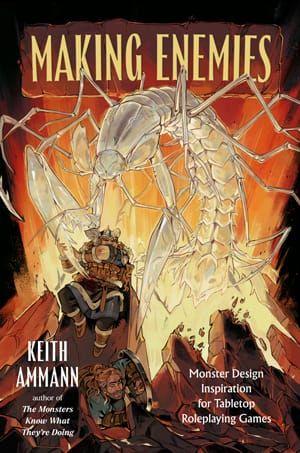
To begin with, exciting news! Last year’s Making Enemies: Monster Design Inspiration for Tabletop Roleplaying Games has been nominated for two ENnie Awards: Best Aid/Accessory (Non-Digital) and Best Writing. I’m not only gratified but excited to be nominated, because this book was a real labor of love. Balloting runs from July 10 through July 19, and I hope you’ll give Making Enemies your No. 1 vote in these categories.
The announcement happened to come right after I released Another Stab at Making Enemies, a supplement to Making Enemies containing all the tips, tools and stat block conversions for Daggerheart that I couldn’t include in the book because my communication with the design team went dead while they were crunching to get the game out. We reconnected at PAX Unplugged, where I finally picked up a copy of the game, and I spent December and January studying the rules and the way adversaries work. Then I spent three months—the last week of February, all of March and April, and the first three weeks of May—playtesting my Daggerheart conversions of Making Enemies’ monsters. Many were easy to convert, and some required only minor fine-tuning. The giant cloak grub and the alpengeist, remarkably, worked exactly the way I wanted them to on the very first try, which hadn’t been the case in any of the other systems I’d designed them for. On the other hand, Vigmar Gravbryter, my reanimated frost giant necromancer, took four tries to get right!
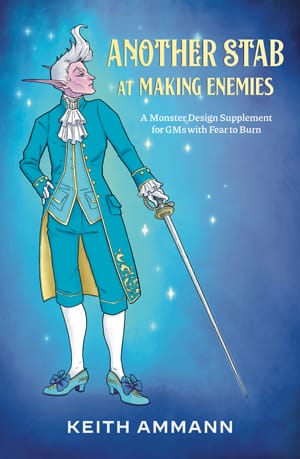
I’ve published Another Stab as a PDF rather than through my usual publisher, partly to get it out as quickly as possible (the gears of trade publishing turn so, so very slowly) but also because its presentation is unusual. On its own, it’s not a complete work. Rather, it’s meant to be used in conjunction with Making Enemies, like downloadable content for a computer game. It’s written in sections, the same way I broke out different sections for D&D, Pathfinder, Shadowdark, the Cypher System and Call of Cthulhu in Making Enemies, and I’ve paginated it so that you can either print it out booklet-style, bind it and place it alongside Making Enemies on your shelf or print it out single-sided, take a pair of scissors, cut it to pieces and insert the pieces directly into a hard copy of Making Enemies where they’d go if they were part of that book!
Speaking of Daggerheart, congratulations to that team on earning four ENnie nominations this year: Best Free Game/Product (for the quick-start adventure “The Sablewood Messengers”), Best Game, Best Rules and Product of the Year! The year that The Monsters Know What They’re Doing was nominated for Best Writing, Mörk Borg ran the table, and I can see Daggerheart doing the same thing this year.
A number of friends have also earned ENnie nominations:
- Ghostfire Gaming’s Grim Hollow Campaign Guide is nominated for Best Setting. Congratulations to Shawn Merwin, Graham Ward, Scott Fitzgerald Gray, Ethan Yen, Andrew Bishkinskyi, Ginny Loveday, Joe Raso and Ben Byrne, who all contributed to it.
- The One Shot podcast’s musical actual-play production of Last Train to Bremen is nominated for Best Streaming Content. Congratulations to Dillin Apelyan and the rest of the cast. (The production comprises podcast episodes 630–33.)
- Monsters of Drakkenheim, also published by Ghostfire, is nominated for Best Monster/Adversary Book. Congratulations to Monty Martin and Kelly McLaughlin, a.k.a. the Dungeon Dudes.
In addition, while I don’t know him personally, I strongly recommend checking out the blog Explorers Design by Clayton Notestine, an incredible combination of graphic design expertise and out-of-the-box systems thinking—for instance, see this post on lessons from urban planning that can be applied to graphic design in tabletop roleplaying games! (I should also note that Notestine, a former ENnie judge, wrote a series of articles about the ENnie nomination process that included priceless intel on when to submit a product for consideration, intel that my publicist and I gratefully made use of. It seems to have worked.)
Also, I was chuffed to see Mystified! receive a nomination for Best Supplement. Mystified! is an expansion to the previously ENnie-nominated Flabbergasted!, a campy (complimentary) RPG of Bright Young Things in a Roaring Twenties–esque setting, engaging in high jinks to elevate the status of their social clubs while their servants bustle around in the background, keeping things from falling apart. (Full disclosure: I was a backer of Flabbergasted! at the Hoity-toity! level. See the guy standing on the table on page 126? That’s me.) Mystified! takes the Flabbergasted! formula and adds dashes of Agatha Christie, H. Rider Haggard and H.P. Lovecraft (minus the gross racism and, er, most of the colonialism). Congrats to author-designers Chelsea and Fleur Sciortino.
In other news, the interior illustrations for Remonstered! The Monsters Know What They’re Doing are finally complete, and we’re in the proofreading stage. It’s off to the printer on July 24 for release on Oct. 6. Electronic advance reader copies should be up on NetGalley very soon! In the meantime, please enjoy these art samples.
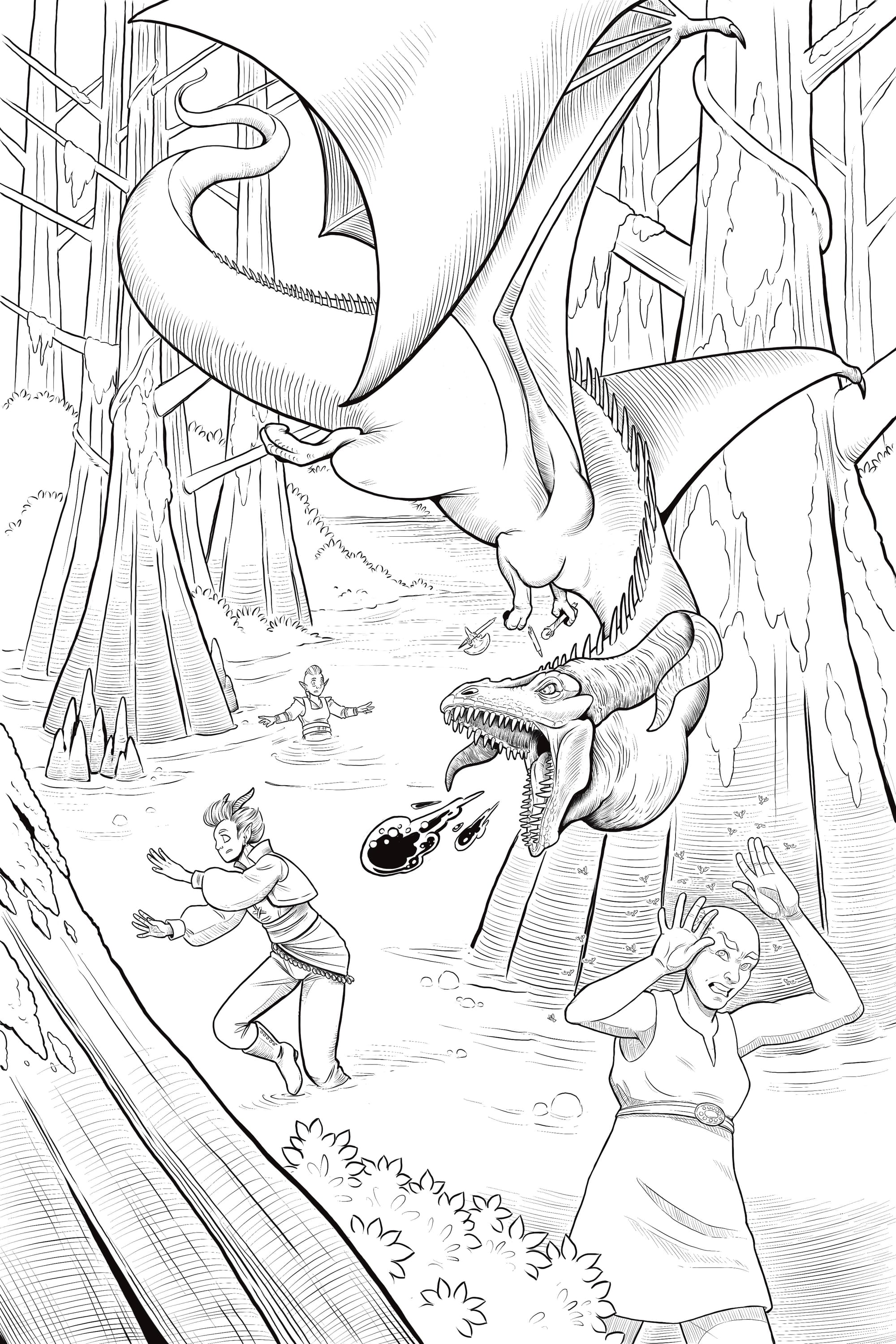
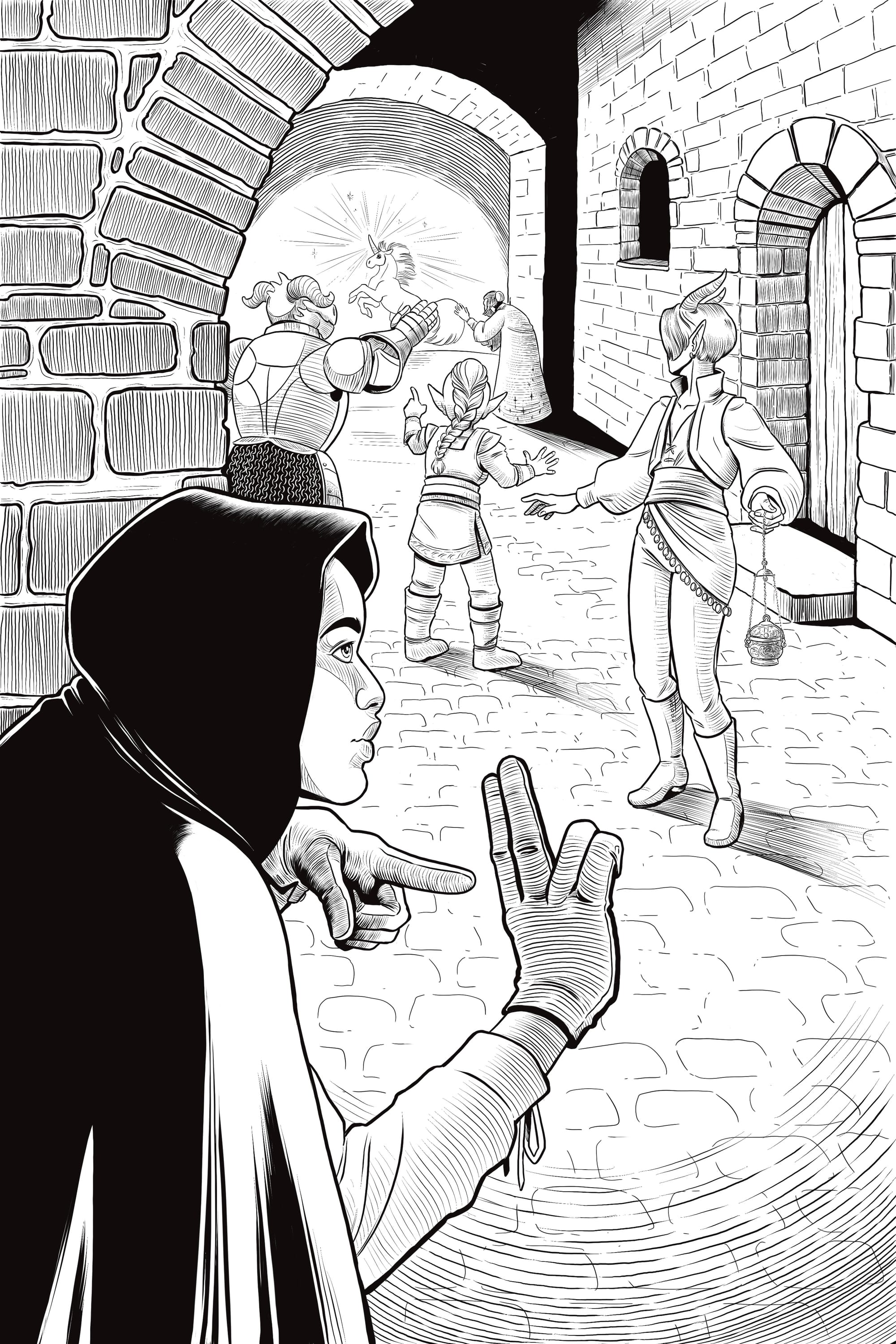
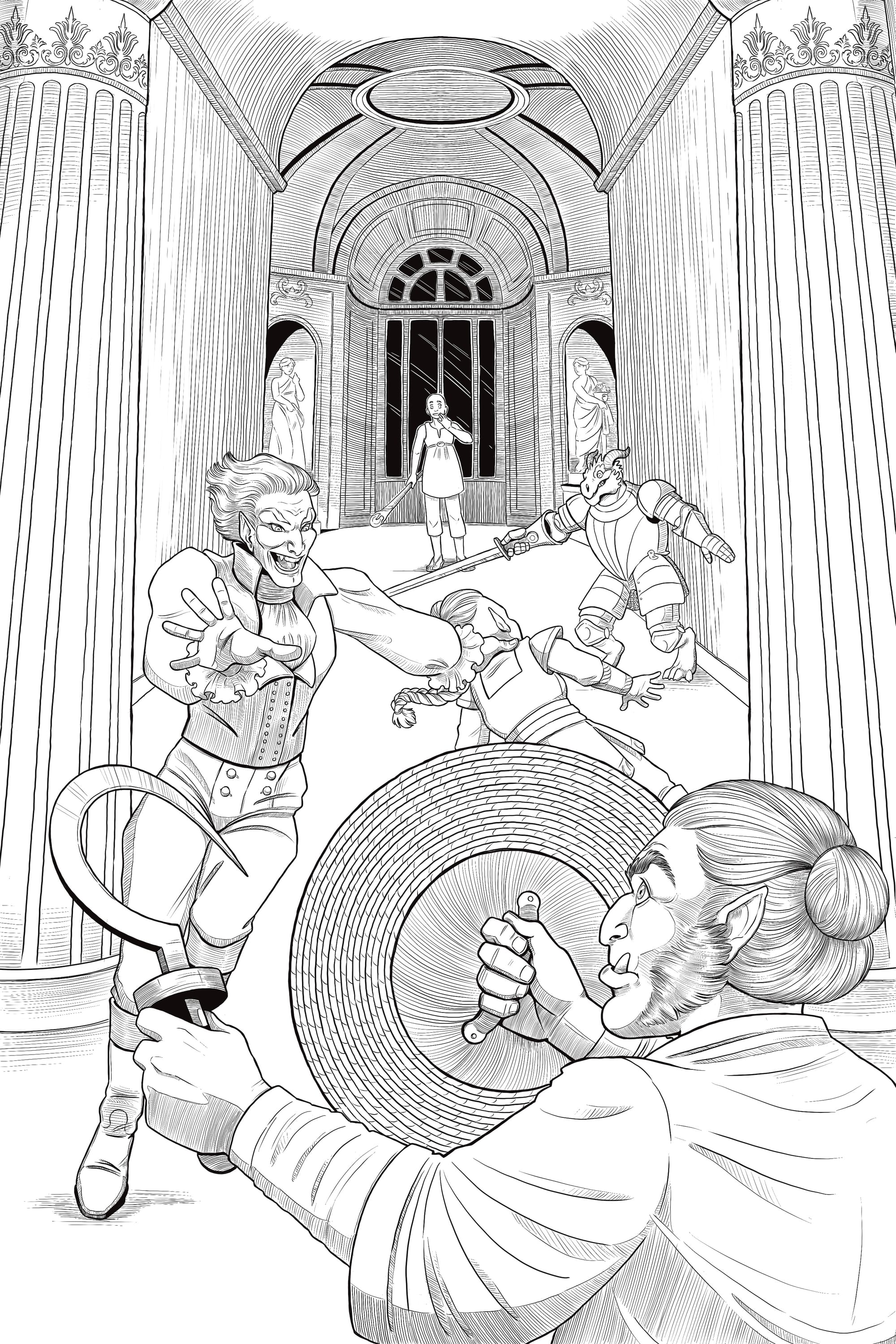
Illustrations by Jen C. Marshall
Finally, my attention was recently directed to a post on the blog Traipse titled “1, 10, or 1000000,” and it’s a work of mind-blowing genius. It asks the questions, “What would it mean for your world if it contained only one dragon, sage, sapient species, magic item or dungeon? What would it mean if your world contained 10 of them? What would it mean if your world contained a million?” Then it answers them, almost perfectly.
There’s only one way I’d elaborate on it: I’d add a “2 percent” level. (The author would probably prefer to call it the “1 percent” level, to stick with powers of 10.) This level is for something that accounts for a percentage of any given thing or population, common enough to have been heard of and even encountered by most people, but rare enough that you're not stumbling across it constantly; you still have to seek it out. For instance, in my own campaigns, spellcasters—all spellcasters, put together—account for about 2 percent of the population. They’re as common in my fantasy worlds as people with Ph.D. degrees are in ours.
The exercise reminds me of the “SCT” principle in the TRIZ engineering method: brainstorming possibilities by positing that size, cost or time is either zero or infinite. That is, how would you solve this problem if you had no money to spend on it at all? How would you solve it if you had unlimited money? How would you solve it if you could take all the time you needed, even centuries? How would you solve it if it had to be done instantly? How would you solve it if you could build a device the size of a planet? How would you solve it if it had to fit on the head of a pin?
“[L]ike most rules of thumb,” the author writes, “it’s best to use when you get stuck or want to try a new approach.” Personally, I think it’s brilliant, and I will absolutely use this principle in worldbuilding going forward.