The Elements of (Gamemastering) Style

As you read this, pretend you’re watching a video of me walking and talking in a scenic outdoor location somewhere. Maybe a forest preserve. It’s not that I couldn’t make a video like that, but I’ve done enough video and audio production before to know how much time and effort it takes to do it right. Also, I don’t feel like spending $500 on a camera that follows me around.
In a recent video, Matt Colville asked, “If somebody came up to you and said … ‘What kind of dungeon master are you?’ what would you say?” Specifically, he was referring to the fact that while people often label players of roleplaying games as being of one type or another, as in Robin Laws’ “Player Types” or the earlier copypasta “Real Men, Real Roleplayers, Loonies and Munchkins” (fun fact: This document went through many iterations and modifications back in the Usenet days, and although I’m not credited for it, I wrote the Shadowrun section as it appears in this version), there isn’t any equivalent schema for game masters.
I actually found out about Colville’s video from watching a response video by Daði Einarsson of the YouTube channel Mystic Arts. To be precise, I watched Daði’s video, then I watched Colville’s, then I watched Colville’s again, then I watched Daði’s again. Each one of those viewings elicited different thoughts, and it took all those viewings for me to decide how to organize them.
So to begin with, I want to put forward an answer to Colville’s question, “What does it mean to even ‘have a style’ as a dungeon master, as a director, as a game master?” Because I have a very definite answer to this question, informed by my graduate study in education and in my undergraduate study in visual art. (Y’all don’t even know what kind of multitudes I contain.)
This answer is rooted in an essay by the mathematician and philosopher Alfred North Whitehead called “The Aims of Education,” which was a critique of the rote nature of U.K. education at the time, very examination-oriented, very credentialist, not very educational. In that essay, Whitehead acknowledged, sure, it’s important that schools teach the basics; everyone needs to know the basics. But the basics alone only give you the tools to accomplish other people’s purposes. They don’t give you the tools to choose and pursue your own purposes. They don’t empower you.
So Whitehead’s position was that education shouldn’t stop at teaching the basics. It should help students achieve such a mastery of the basics that the basics become automatic, and students can stop thinking about what they need to do and turn their attention to how to do it, and develop the ways of doing things that work best for them. And the term he used for that was “style.”
In Whitehead’s words:
Style, in its finest sense, is the last acquirement of the educated mind; it is also the most useful. It pervades the whole being. … With style you attain your end and nothing but your end. With style the effect of your activity is calculable, and foresight is the last gift of gods to men. With style your power is increased, for your mind is not distracted with irrelevancies, and you are more likely to attain your object.
Style, in other words, is the precursor to power—which by Whitehead’s definition meant being able to set your own goals and pursue them successfully.
And that hews fairly closely to the artistic idea of style—the choices you make once you’ve mastered the fundamental techniques of putting paint on canvas or light on film or movements on a stage—although in art style is often more closely tied to artistic movements. But who’s to say we don’t have movements in GMing style, too? It’s pretty inarguable, actually, that today’s GMs are inclined toward different ways of doing things than the GMs of just 10 years ago, who themselves were inclined toward different ways of doing things than the GMs of 20 or 40 years ago. I think we’re in something of a hundred-flowers-blooming period with respect to GMing styles. And we’re all evolving constantly, either through our exposure to these various styles or through our isolation from them. None of us is frozen in time.
But as Colville pointed out in his video, our vocabulary for naming and describing these styles is still somewhat impoverished. It’s still more of an “I know it when I see it” kind of thing than something we can discuss in shared, mutually understood terms. And, more to the point, “style” isn’t the same thing as “type,” and we shouldn’t make the mistake of conflating them. “Type” is what you get when you notice that GMs tend to self-sort into clusters, with one group manifesting styles that are all fairly close to one another in the choices they make, another group manifesting styles that are close to one another but observably distinct from that first group, and so on.
Do we have enough data points to be able to say that this is in fact true? I don’t know. I’m not sure anyone’s studied it systematically. And it’s something that would need to be studied systematically, because as Daði pointed out, all of us who’ve been doing this stuff for a while have been exposed to all sorts of players, but the number of GMs each of us has played with tends to be small. We need bigger samples and better metrics.
So let’s think about our metrics.
I think Colville identified an important aspect of what it means to have a style as a GM when he drew this distinction between the player role and the GM role: “The players are running one character. The director is running the world.” When someone asks, “What kind of GM are you?” a major part of that question is, “How do you run the world?”
Colville drew one distinction between himself and certain other GMs:
I am principally concerned with the world. I feel like that's my job—to set it up, make it consistent, make the people in it plausible. And it's the players’ job to figure out how they find their way in. … And I contrast this with the kind of director—which I definitely am not—who is principally concerned with their player characters’ plight, their internal state. You know, these are games that are run by people who like having player characters with backstories that have a lot of drama in them, and they work hard to make sure that that drama plays out over the course of the campaign. If your character has unresolved father issues, for instance, well, that kind of director is going to make sure that we meet your dad, and we’re gonna play that drama out. I love that stuff. I think it’s really cool. It’s just not my style.
This spectrum extends even further into the realm of “the campaign setting as, essentially, an amusement park,” he noted in a comment on his own video.
A: nothing feels remotely real. The whole point of a theme park is you are “leaving the real world behind.” And B: everything that happens there is **for you**. In this analogy, for the heroes. Everything in the world only exists to further their story. Instead of a world populated by people, you’ve got “cast.” Everyone you meet is an actor on the payroll there to put on [a] show … for you.
These observations cut to the heart of one axis of GMing style: whether the world exists around the PCs, wholly independent of them, or for the PCs, wholly dependent on them, or somewhere in between.
Another axis, I’d say, involves worldbuilding, which is related to world-running but largely prior to it. At one end of this axis is the creator, who invents an entire world from scratch, borrowing nothing. At the other end is what we might call the tenant, who only runs games in worlds built by others and adheres religiously to their canon lore.
I’ve observed GMs who operate at each end of Colville’s “around the PCs” vs. “for the PCs” axis, but the ends of this worldbuilding axis are almost cartoonish extremes: I’ve never encountered a GM who never borrowed anything at all from anybody, nor have I ever encountered one who never added anything of their own. If you don’t borrow anything at all, your players will have a hard time fitting it into their own experience, and you’ll struggle to hold their interest. But if you do nothing but borrow, never putting your own twists on it, they’ll sense that they’re not getting anything from you that they couldn’t get elsewhere.
So I think the archetypal examples of these worldbuilding styles are more “90/10”: 10 percent borrowed and 90 percent original, or 90 percent borrowed and 10 percent original. Let’s call the first of these “the innovator,” who builds a brand-new edifice around just a few familiar foundation stones, and call the second “the interpreter,” who takes someone else’s setting but puts their own stamp on it, making it feel fresh and distinctive. And let’s also note that some well-known GMs have built wildly loyal fan bases with a “60/40” approach, taking many familiar elements but placing them in substantially new contexts—Keith Baker (Eberron) and Matt Mercer (Exandria) being two instantly recognizable examples. Let’s call this type “the remixer” (and not sweat the exact proportions too much—anywhere between the 40-yard lines counts).
But running the world isn’t the GM’s entire role. The GM also runs the table. They’re the meeting chair, the agenda-setter. They may be more or less open in inviting and accepting player input into that agenda—for instance, if a player says their character has a particular goal they want to pursue, or if the GM asks the players to contribute details to a scene being described. They may favor “sandbox” adventures over “railroad” adventures, or vice versa, although I’d be cautious with attributing too much of that to GM style, since linearity vs. nonlinearity is often a function of whatever adventure a GM is running, and not all GMs write their own adventures. It’s also subject to player preference: I have a group of players who, if I give them too much freedom to set their own priorities, go into low-power idle mode. Responding to players’ demonstrated tendencies isn’t a matter of GM style. It’s a skill issue.
However, willingness to allow players to go off on tangents vs. increasing the pressure whenever they lose sight of the main threat is definitely a GM style variable. So is willingness to fudge the rules to accommodate players who want to do things the rules don’t envision or don’t normally allow. So is limiting the options available to players during character creation. We can broadly characterize this group of GM characteristics as “tight” vs. “loose”: A GM may be plot-tight or plot-loose, rules-tight or rules-loose, options-tight or options-loose.
I’ll confess here and now that I tend to be very tight when it comes to rules and character creation options, because I believe in my bones that bounded creativity produces more interesting results than unbounded creativity. Whether I’m plot-tight or plot-loose depends a lot on what adventure I’m running: I ran Tomb of Annihilation very plot-tight, to keep my players oriented toward the threat they were charged with neutralizing, but I haven’t felt the need to do that with other adventures. I tend to believe that if the PCs themselves are interesting and compatible with the adventure and with one another from the start, they’ll find interesting ways to work within the rules as written and interesting directions in which to advance the story. And since I’m rules-tight with myself as well as with my players, I’m not offending against anyone’s sense of justice.
A technique I bring to character creation is something I call the “zoning code,” a document I send out to players letting them know which character creation options are unconditionally permitted, which ones need my review and approval, and which ones are prohibited. I use this technique to ensure character compatibility and consistency with the tone and theme of the adventure, and I write a different zoning code for each campaign. (Usually, for instance, I don’t allow evil PCs at all, but when I ran Curse of Strahd, I designated lawful evil and neutral evil as alignments that players could choose as long as they ran it past me first. One player took me up on it.)
The zoning code is my own invention; I’ve never known another GM to use it, and some people (many people?) might consider it so tight as to cause constipation. But I’ve never had a player complain about it, and when I think about games I’ve played in which character creation was a free-for-all—resulting in characters such as a triton rogue named Aqua Velva—and how impossible it was for me to get emotionally invested in those campaigns, I feel pretty secure about continuing to use it.
Other variables? I mentioned being more open or more closed to player input; a big style consideration that’s emerged in this past decade is the extent to which GMs ask players to fill in details of a scene. As a player, I hate being expected to supply these details. It’s not my job! My job is to develop my character, to get into their head, to decide how they interpret events and react or respond to them. I can’t do that authentically if I’m also inventing the stimuli that they’re supposed to be reacting or responding to. And since I believe in the Confucian rule of reciprocity, “Don’t do to others what you don’t want done to you,” I’m not going to impose that responsibility on my players—at least, not after session zero.
In his video, Colville mentioned “theatricality,” which he also characterized as “Doing the Voice.” “I don’t tend to Do the Voice,” he said. “I think it’s kind of gimmicky. It doesn’t tell me anything about your character, their heart.” Respectfully, my opinion on this issue differs from his. I don’t consider it gimmicky; I consider it useful, not for gaining insight into non-player characters (and of course, some NPCs are trying to mislead the PCs, not help them gain insight) but simply for telling them apart. If I always have elves speak in an Irish or Welsh accent, then when you’re talking with Irish- or Welsh-accented NPCs, you remember that they’re elves.
Now, granted, I’m pretty good with languages and accents, and as Daði pointed out in his own response video, GMs tend to like to lean into their strengths and the things they enjoy the most. I was a communication major in college (alongside my photography major), so naturally, I tend to concern myself with how characters communicate with one another. A GM who doesn’t have the same facility for Doing Voices isn’t going to find trying to Do Voices to be as useful in distinguishing NPCs from one another. So is this a style issue or a skill issue? I feel safe calling it a style issue, since our strengths inform our styles: We lean hardest on the techniques we get the most benefit out of, and the better we are at something, the more benefit we’ll get out of it.
One thing neither of them mentioned is session prep, which is absolutely a matter of GM style, even though it’s often invisible to players at the table. If I’m going to cite an example of two widely diverging styles with respect to prep, I’ll choose myself and Mike “Sly Flourish” Shea. Shea has published a series of books for the “Lazy Dungeon Master.” I am the polar opposite of lazy when it comes to my prep. I want to think through as many eventualities as possible beforehand so that I don’t have to think about them any further during a game session. I want to establish facts about my campaign world and keep them consistent. (Largely, this is because I’m sensitive to contradictions and plot holes, and I have players—most of all, my spouse—who are extremely sensitive to them, so I go out of my way to prevent them.) Shea, on the other hand, is extremely comfortable with making up secrets about his world for the players to discover—and then throwing them out entirely if the PCs don’t dig them up. He’ll make up entire encounters on the fly. I’m not comfortable doing that: If an encounter is possible, I want to have who’s involved and what their battle plans are already nailed down. (This isn’t to slight Shea in any way—in fact, I love his book Return of the Lazy Dungeon Master because it helps me focus first on the details that will provide the most return on my time investment; I still go down all my other various rabbit holes, but I can do that after I’ve nailed down what’s most important.) Call us “the premeditator” and “the extemporizer”—or “the prepper” and “the ad-libber” if you want something punchier, although it inaccurately suggests that GMs like Shea don’t do any prep at all and that GMs like me never ad-lib.
One thing Colville brought up as a possible style axis—and then promptly dismissed—was, “Is your game combat-heavy or roleplay-heavy?” He dismissed it on the valid grounds that this question depends more on what kind of game you’re playing and what kinds of players you’re playing with. But I’d go further and say that it puts forth a false dichotomy. Combat and roleplay are in no way mutually exclusive. On the contrary, combat offers almost infinite opportunities to roleplay combat expertise. (Yes, even in Dungeons & Dragons, which Colville threw unsubtle shade at when he characterized D&D combat as “deliberately annoying.”) You can absolutely have combat encounters full of rich, thick, chewy roleplaying, just as you can have exploration encounters and even social interaction encounters with little or no roleplaying at all. Every encounter is what you make it. If anything, “combat-heavy” and “roleplay-heavy” are two sliders on Colville’s hypothetical GM equalizer, either of which can be set low or high. A good GM can roleplay the freaking environment in an exploration encounter. It’s only a matter of realizing that that’s something you can do, and then deciding that you will.
Beyond all these two-axis variables, there are other intangibles, the things that make each GM unique. “Style is that thing that is still there when you subtract everything else, the thing that is always true no matter what game you’re running,” Colville asserted. “What are the things that are always true about your game, about you as a director, about what's important to you?” Daði identified government conspiracies as a recurring motif in his own adventure campaigns. For me, resistance to tyranny seems to come up again and again, along with discrepancies between what different groups and creatures know and don’t know, and the unintended consequences of misunderstandings. I’m also fastidious about having every group, every character, every creature act according to its nature, even if—especially if—it causes complications.
But now we’re down to such an individual level that we’ve bypassed the question that kicked this whole discussion off: “What kind of dungeon master are you?” A question asked expecting an answer that’s not simply a description of one’s individual style but rather is part of a typology. That typology doesn’t exist for DMs, not yet. (Well, it sort of does, but it doesn’t seem to have caught on.) And since we don’t have broad enough experience, a large enough sample, to be able to assign categories based on gut-level pattern recognition, it’s something we’d have to go about systematically (he says, of course, as someone who also minored in sociology). Create a GM personality inventory; solicit Likert scale responses on all the different axes we’ve identified. Administer the inventory to as many GMs as we can get to take it. Review the data and look for clusters in their answers, which scales correlate positively and negatively with one another. There are your types. Put apt names to them. Secure your place in RPG history.
It’d be a grand social science experiment for whoever wanted to put the effort into conducting it. I’d pay good money to see the results, but don’t think I’m the one to conduct it. I’m already spending what little free time I have on session prep.
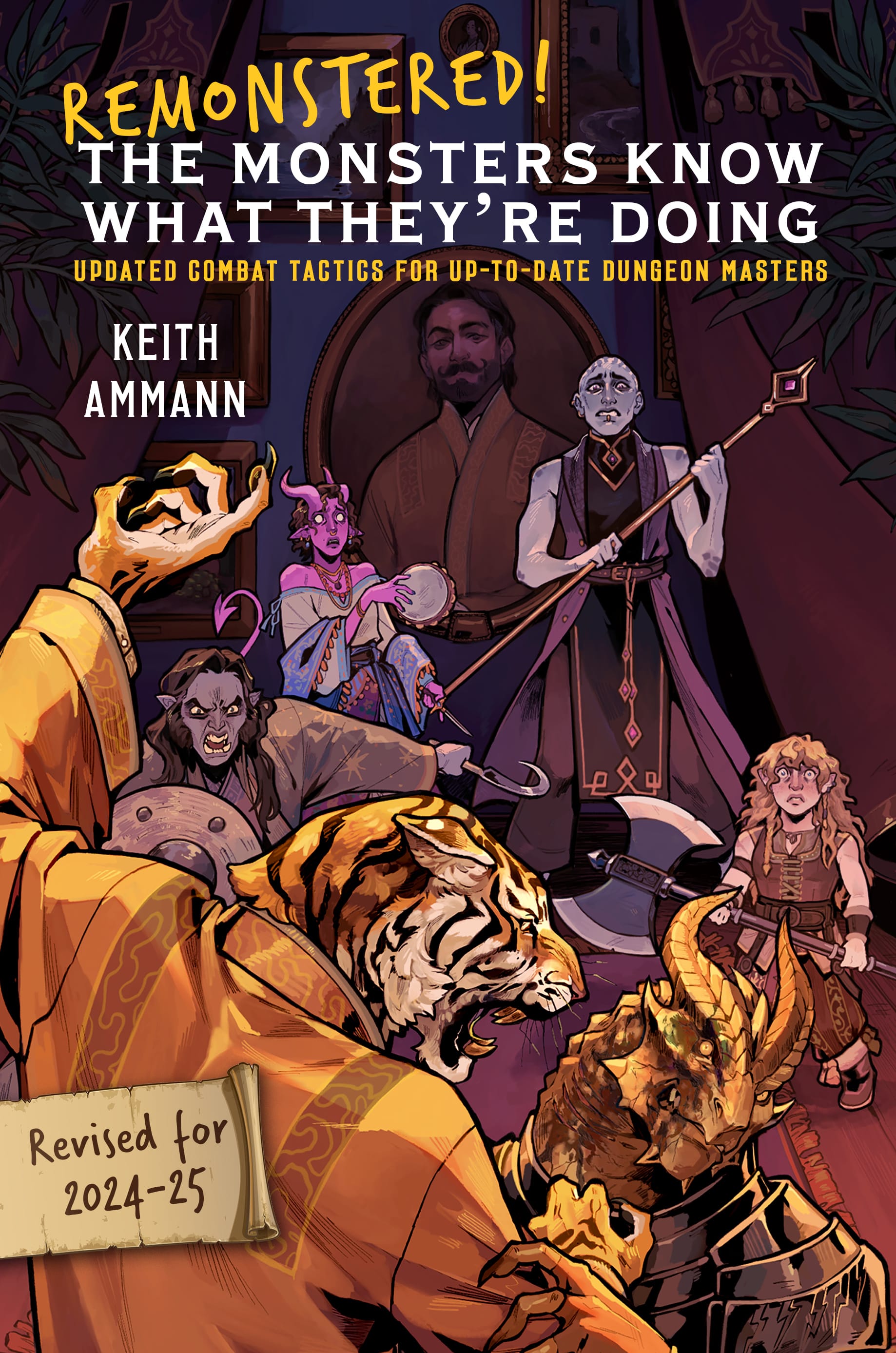
In Remonstered! The Monsters Know What They’re Doing, every monster’s tactics are updated to reflect the recent changes to their stat blocks in the 2025 Monster Manual and accompanied by brand-new tips to help you prepare the battlefield, choose allies and minions, and take your combat scenes in exciting, unexpected directions. (Not to mention another banger cover by Lio Pressland and all-new interior illustrations by Jen C. Marshall!) This revised edition hits shelves Oct. 6, but you can preorder it now from Bookshop, Barnes & Noble, Amazon, Indigo or your favorite independent bookstore in the United States or Canada.

And if you’ve decided to stick with the original 2014 fifth edition Dungeons & Dragons rules, fret not: The original The Monsters Know What They’re Doing will still be available alongside the revised edition.