Unfulfilled by the Guild

The Dungeon Masters’ Guild turned 10 years old this past month, and Teos Abadía and Shawn Merwin presented a retrospective in a couple of videos they released in December (1, 2). There’s really no denying at this point that the DMs’ Guild is in decline, possibly irreversibly, thanks to a deluge of generative AI slop, poor product and author discoverability, and Wizards of the Coast’s refocusing its attention onto D&D Beyond (which it now owns) as a distribution platform for third-party products.
There’s also no denying that the time to get in on the DMs’ Guild, if you wanted to make a real go of it, was between 2017 and 2019.
I posted my first product to the DMs’ Guild in April 2020. Sigh.
In contrast with the success I’ve enjoyed in trade publishing, it really is kind of sad-laughable how little traction my DMs’ Guild products have ever gotten. In my entire time on that platform, I’ve earned slightly less than $2,000 from all my products put together, despite a royalty rate that’s significantly more favorable than what I get from my book publisher. That’s not a complaint, necessarily: My royalty rates are competitive with those of other book authors. It’s just kind of amazing how low trade royalty rates are relative to the list prices of books—and even more amazing that some of us can make a living at it anyway, because trade publishing sales volume dwarfs that of tabletop roleplaying game publishing. By how much, you may be wondering? Well, my lifetime royalties on the DMs’ Guild from all my products put together are approximately equal to what I was earning from a single week of book sales as recently as 2023.
Fifty-nine percent of those lifetime earnings have come from one title, “We See It Differently: Bringing Factions Into Conflict.” Second place in terms of copies sold is my Oath of Deliverance paladin subclass, but it accounts for only 8 percent of my earnings, because it was included in a discount bundle once; in terms of copies sold at full price and royalties earned, it’s performed more poorly than a product I created as part of an April Fool’s joke. I was and still am proud of that subclass, and it’s the only product that I paid an outside illustrator to create a cover for. To date, it’s earned 54 percent of the cost of that cover.
Since Oct. 1, 2025 (my book royalty periods end on March 31 and Sept. 30, so I track all my other royalties on the same schedule), my DMs’ Guild earnings total $30.88.
For all these reasons, I haven’t seriously considered posting new content to the DMs’ Guild for some time now, but today I’ve decided to take a more drastic step. I can’t actually pull my products from the DMs’ Guild and make them available elsewhere, because under the site’s terms, WotC owns the content now. Instead, all my DMs’ Guild products are now pay-what-you-want, with a recommended price of zero dollars and zero cents.
Why am I doing this? Because it was never about the money. For me, the Dungeon Masters’ Guild was a place for me to share work that didn’t fit into anything else I was doing. But if no one’s seeing it, it’s not accomplishing that goal, is it? So I figure, if it’s free, maybe a few more people will actually see it, use it and enjoy it.
I’ll also share some of the material I was working on for future DMs’ Guild publication in this newsletter. I’m known as the Monster Guy, but for a while, I was pretty into subclass design. That interest produced Oath of Redemption and Circle of the Cryptid, which made it onto the Guild, but I was actually working on subclasses for all the fifth edition Dungeons & Dragons classes. The trouble was, some subclasses simply comprise too few words to sell with a $1.99 price tag. Have you ever really looked at how short rogue subclasses tend to be—those that aren’t Arcane Trickster, at least? Many of them wouldn’t fill half a page. So I was in the process of assembling a large package of subclasses … when the 2024 rules revision came along, and a whole bunch of those subclasses didn’t work anymore.
These subclasses included a ranger inspired by public health professionals, guarding their lands against disease; sea shanty and conductor bards that coordinated the timing of their allies’ actions; cleric domains associated with hearth and messenger gods; an absurd sorcerer origin called Favored by Squirrels (“When you think about it, is it really any less plausible than any other source of magical power?”); and a really complicated one-third-caster monk subclass that could inscribe protective talismans and cast spells by drawing glyphs in the air, which never really came together. To be honest, quite a few of these subclasses weren’t yet ready for prime time. But some were, and I’ll share a few of them below—starting with my two rogue subclasses, which I think were the best of the unpublished lot.
Rogue
Con Artist
You are a master of the art of exploiting others’ greed, dishonesty, vanity, opportunism, compassion, desperation, and naïveté for your own gain. Whether carrying out a fast swindle in minutes or a long con over days or weeks, you know just how to appeal to a mark’s weakness, earn their trust, string them along, and cut them loose.
Bluffmaster
When you choose this archetype at level 3, you gain proficiency in Deception and Insight if you don’t already have it, and with either the disguise kit, the forger’s kit, or one gaming set. Your proficiency bonus is doubled for any ability check you make that uses any of these proficiencies.
Quick Change
Starting at level 3, you can use the bonus action granted by your Cunning Action to make a Dexterity (Sleight of Hand) check, take the Use an Object action, or don or doff an item of outer clothing such as a hat, a coat, a mask, or a pair of gloves or boots.
Confidence
Starting at level 9, you have advantage on Insight checks, and other creatures have disadvantage when using Insight to contest your Deception.
Accomplices
Starting at level 13, you can enlist confederates to help carry out your schemes. When you complete a long rest, choose a number of other creatures up to your Charisma modifier (minimum 1). These creatures can be any distance from you, but you must be known to each other, and they must be able to understand you. For 24 hours, these creatures add your proficiency bonus to their Charisma (Deception) checks.
Catch Me If You Can
Starting at level 17, when you use your Cunning Action to Dash, you can also make a Dexterity (Stealth) check to attempt to hide. In addition, you can attempt to hide even when you are only lightly obscured from your target.
Hooligan
Not every rogue is subtle, clever, or a loner; some are straight-up thugs. A brutish street fighter who doesn’t waste time considering what it means to “fight fair,” you work best alongside confederates who can occupy your foes’ attention—the better for you to sucker-punch them. Dirty tricks and arm-twisting are your stock-in-trade. While other rogues go about their work with finesse and ingenuity, as far as you’re concerned, a club is as good as a sword when swung at the right moment … and the right location.
Bully
When you choose this archetype at 3rd level, you gain proficiency in Athletics and Intimidation if you don’t already have it. Your proficiency bonus is doubled for any ability check you make that uses either of these proficiencies.
Direct Approach
Starting at 3rd level, you can use Sneak Attack when making an unarmed strike or any melee attack using a weapon you’re proficient with, including improvised weapons.
Terrorize
Starting at 9th level, when you make an Intimidation check against a creature, regardless of which ability you use, your target is frightened of you for 1 minute if the number on the die is 19 or 20, unless the target is immune to the frightened condition. If the ability check is part of a skill contest, the frightened condition is imposed before the target makes its roll to oppose.
You must spend an action to make an Intimidation check using this feature during combat. The frightened condition ends if you make an attack roll and miss while the frightened creature can see you.
Dirty Tricks
Starting at 13th level, you can use your Cunning Action to make a grappling or shoving attack.
While They’re Down
Starting at 17th level, when you hit a prone target with a melee attack, your Sneak Attack damage against that target increases by 3d6, and the target must use its full movement to stand up before the start of your next turn.
Changes to initiative in 5E24 meant a total rework of the Guerrilla subclass’s capstone ability was in order, and I didn’t feel strongly inclined to put in the effort. But I watched my friend Mike Balles play a Guerrilla fighter under 5E14 rules in a convention game, and it was pretty awesome. This subclass duplicates some features of the rogue class’s Scout archetype, but those features appear in a different order, reflecting the different emphases of the two subclasses: The Scout’s focus is on exploration and reconnaissance, while the focus of the Guerrilla is on achieving and exploiting surprise in combat. Parts of the subclass are explicitly inspired by the writings of Che Guevara.
Fighter
Guerrilla
The Guerrilla studies the techniques of fighting stronger foes by taking advantage of the elements of surprise, deception, and superior mobility. Guerrilla fighters move in secret, study their enemies’ strengths and weaknesses, strike when their enemies are unready, withdraw when their enemies counterattack, and counterattack when their enemies withdraw, not letting up until their foes lose the will to fight.
Bonus Proficiencies
When you choose this archetype at 3rd level, you gain proficiency in two of the following skills: Deception, Perception, Persuasion, and Stealth.
Swift Strike
Starting at 3rd level, as long as you are not wearing armor that imposes disadvantage on Stealth checks, you have advantage on initiative rolls. In addition, you can use your bonus action to make an attack roll against a creature that hasn’t yet taken a turn in combat.
Move Like the Wind
Starting at 7th level, as long as you are not wearing armor that imposes disadvantage on Stealth checks, your walking speed increases by 10 feet. If you have a climbing or swimming speed, this increase applies to that speed as well.
Gather Intelligence
Starting at 7th level, when you spend at least 1 minute observing one or more targets, you gain advantage on all attacks against them until they take an action in combat.
Strike Fear
Starting at 10th level, when you hit a creature that hasn’t yet taken a turn in combat with an attack, every creature of your choice within 30 feet of your target who can see it must make a Wisdom saving throw. The DC for this save is equal to 8 + your proficiency bonus + your Constitution modifier. On a failed save, a creature is frightened of you for 1 minute. The creature may repeat this saving throw at the end of each of its turns, ending the effect on a success. If a creature’s saving throw is successful or the effect ends for it, it is immune to this feature for the next 24 hours.
Take to the Hills
Starting at 15th level, you are not slowed by nonmagical difficult terrain.
Melt Away
Starting at 15th level, you can Disengage as a bonus action.
Confounding Onslaught
Starting at 18th level, any creature surprised by you at the beginning of combat can’t move or take an action on its first or second turn of the combat encounter and can’t take a reaction until the second turn ends.
Published subclasses give warlocks access to fiend patrons, fey patrons, aberration patrons, celestial patrons, elemental patrons and undead patrons. I thought: What about beasts and plants? The Monarch of Beasts patron is meant to give Princess Mononoke, while the Veteran Tree patron is something all its own. Again, these are designed for use with 5E14; 5E24 has effectively deprecated Wisdom (Perception) checks using specific senses, replacing advantage on all such checks with double proficiency, and magical attacks almost always deal a mystical damage type (force, necrotic, psychic or radiant).
Warlock
Monarch of Beasts
You have sworn yourself to the service of a mighty animal entity, revered by those of its kind as a monarch or deity. This great and awesome beast protects its subjects from the depredations of all who threaten them—not just unnatural creatures, but humanoids as well—and by extending its power to you as your patron, it expects the same of you.
Monarch of Beasts Expanded Spells
Spell Level |
Spells |
1st |
animal friendship, speak with animals |
2nd |
animal messenger, locate animals or plants |
3rd |
conjure animals, protection from energy |
4th |
dominate beast, polymorph |
5th |
awaken, commune with nature |
Natural Defenses
Starting at 1st level, you have advantage on Wisdom (Perception) checks that rely on smell. Additionally, as a bonus action, you can manifest claws, fangs, spines, horns, or a different natural weapon of your choice. When you manifest a natural weapon, your unarmed strikes deal 1d6 bludgeoning, piercing, or slashing damage, as appropriate to the natural weapon you chose, and you are proficient with your unarmed strikes. When you attack with your natural weapon, you can use your Charisma modifier, instead of Strength or Dexterity, for the attack and damage rolls. You can also use a bonus action to retract your natural weapon.
Clutching Jaws
Starting at 6th level, when you hit a creature with an attack, you can conjure a force that seizes and holds it, as if it were caught in the jaws of a mighty beast. The target creature is grappled and takes 1d6 force damage at the start of each of its turns. It can use an action to attempt to escape by succeeding on a Strength (Athletics) or Dexterity (Acrobatics) check against your warlock spell save DC. You must finish a short or long rest before you can use this feature again.
Impenetrable Hide
Starting at 10th level, you are immune to piercing damage from nonmagical attacks and have resistance to piercing damage from magical attacks.
Bestial Aspect
Staring at 14th level, you can use a bonus action to momentarily take on the aspect of your patron. Until the start of your next turn, your size becomes Large, your Armor Class increases by 2, and your speed increases by 10 feet. While in this form, you can use an action to make two melee weapon attacks using your spell attack modifier. Each attack deals 2d6 + your Charisma modifier bludgeoning, piercing, or slashing damage (your choice) on a hit and is magical. Whether you hit or miss, each target creature must make a Wisdom saving throw against your warlock spell save DC or be frightened by you for 1 minute. You must finish a short or long rest before you can use this feature again.
Veteran Tree
Your patron is an ancient, awakened tree of exceptional size, venerated by treants, dryads, and other forest dwellers. It may be a noble, benevolent guardian of life; a distrustful steward, aggressive toward trespassers; a malevolent presence spreading gloom and corruption; or even a living conduit linking many cosmic planes. With thousands of years of knowledge in its rings, such a patron pursues its goals across many generations.
Veteran Tree Expanded Spells
Spell Level |
Spells |
1st |
entangle, fog cloud |
2nd |
barkskin, locate animals or plants |
3rd |
plant growth, speak with plants |
4th |
confusion, conjure woodland beings |
5th |
awaken, tree stride |
Deep Roots
Starting at 1st level, you have advantage on saving throws against being knocked prone or moved against your will. At 10th level, you become immune to these effects.
In addition, you can draw on the power of the life-giving earth to heal yourself. At the beginning of your turn, you can touch the ground and regain hit points equal to your warlock level plus your Charisma modifier (minimum of 1 hp). Your speed becomes 0 until the end of your turn. You can’t use this healing power again until you finish a short or long rest.
Winter Turns to Spring
Starting at 6th level, when you become stable after succeeding on at least one death saving throw, you regain consciousness with hit points equal to 2 × your warlock level. Once you use this feature, you can’t use it again until you finish a short or long rest.
Hardy
Starting at 10th level, you have resistance to cold damage.
Lost in the Woods
Starting at 14th level, you can subject a creature to a bewildering illusion. As an action, choose a creature that you can see within 60 feet of you. It must make a Wisdom saving throw against your warlock spell save DC. A creature with truesight succeeds on this saving throw automatically. On a failed save, the creature is frightened by you (your choice) for 1 minute or until your concentration is broken (as if you are concentrating on a spell). The effect ends early if the creature takes damage from any other source.
Until this illusion ends, the creature is disoriented, believing itself to be wandering in an endless forest, the appearance of which you choose. The creature can see and hear only itself, you, and the illusion. At the beginning of each of its turns, the creature takes 3d10 psychic damage, which it believes to be inflicted by a shadowy, fast-moving forest denizen, a lashing branch, or some other hazard appropriate to the illusion. If it uses its movement, it moves in a random direction. The creature can repeat the saving throw at the end of each of its turns, ending the illusion on a success.
Once you use this feature, you can’t use it again until you finish a long rest.
Upcoming Appearances
I’m traveling from the war-torn hellscape of Chicago to the war-torn hellscape of Portland, Ore., for GameStorm, March 19–22. I’m running two games there, one D&D and one Cypher System, along with a two-hour, participatory monster design workshop. Badge sales are live; click the link above to buy yours.
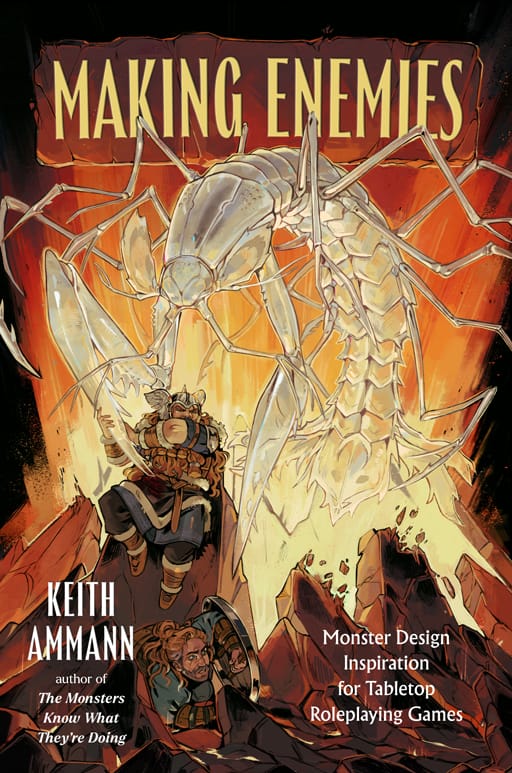
In The Monsters Know What They’re Doing, the essential tactics guide for Dungeon Masters, and its sequel, MOAR! Monsters Know What They’re Doing, I reverse-engineered hundreds of fifth edition D&D monsters to help DMs prepare battle plans for combat encounters before their game sessions. Now, in Making Enemies: Monster Design Inspiration for Tabletop Roleplaying Games, I explore everything that goes into creating monsters from the ground up: size, number, and level of challenge; monster habitats; monster motivations; monsters as metaphors; monsters and magic; the monstrous anatomy possessed by real-world organisms; and how to customize monsters for your own tabletop roleplaying game adventuring party to confront. No longer limited to one game system, Making Enemies shows you how to build out your creations not just for D&D 5E but also for Pathfinder 2E, Shadowdark, the Cypher System, and Call of Cthulhu 7E. Including interviews with some of the most brilliant names in RPG and creature design, Making Enemies will give you the tools to surprise and delight your players—and terrify their characters—again and again.
Order today from your favorite independent bookseller, or click one of these links:
Spy & Owl Bookshop (hi it me) | Barnes & Noble | Indigo | Kobo | Apple Books | Libro.fm | Audible