A Shift in Focus

Over the weekend, I received a copy of the new Cypher Character Rulebook as a backer reward. I’d already received the book in PDF a while back and given it a once-over, but with the hardcover in hand, I decided to give it a more thorough examination.
Before I talk about it, I should make clear that what I’m looking for in a revised edition of the Cypher System isn’t necessarily what the designers were hoping to achieve by it, and to give it a fair shake, I need to address what they were trying to do along with—and, for that matter, prior to—what effect their choices have had on my own appreciation of the game.
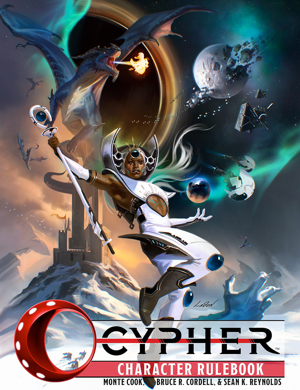
But first, the cover: A bold illustration by Katerina Ladon, who also created many of what I found to be the most striking and appealing illustrations in the 2024 Dungeons & Dragons Player’s Handbook. The inside cover endpapers and title page feature two more Ladon illustrations, as if to say, “You know that anything-goes wild high fantasy trend that everyone in the industry is following right now? We’re on board, too! Don’t forget us!”
Ahem. Anyway.
On pages 4 and 5 of the CCR, author/designer/creative director Monte Cook discusses some of the motivations behind the new edition:
I think it’s safe to say that no one on the planet has logged more hours playing and running this game than this team. And I daresay that experience matters. It matters because it’s taught us what needs to change and what needs to remain the same.
Our team has also spent a lot of time reading what people say about the game online. We talk to people at conventions and game stores. Many of these people are huge fans of the game with lots of experience using the rules themselves. Others found that the game wasn’t for them for various reasons. Regardless, we listened to everyone and took every bit of feedback seriously. … Tens of thousands of people have played some version of Cypher and probably found things they loved and other things they loved less. We’ve worked hard to use all that gameplay as the foundation of this new edition of Cypher.
In other words, the designers are responding directly to years of feedback. Personally, I’ve never been in a position to provide any of that feedback myself. If they’d asked me, I’d say they had a strong successor to GURPS in the genreless roleplaying game system category which only needed a few kinks ironed out:
- A better presented character sheet, with better tracking of things that ease and hinder task difficulty.
- Better explanations of Pools and Edge.
- Better explanations of how to use cyphers and how often to award them, along with a wider variety of subtle cyphers.
- Better rules for spellcasting.
- Better defined polearms.
- Clearer vehicle combat rules.
- A Maker type to go along with the Warrior, Adept, Explorer and Speaker.
In this CCR, I got better explanations of Pools and Edge, at least.
Mostly, though, the changes in this new edition are orthogonal to my own concerns. They seem, both at first glance and on closer examination, to be intended to make Cypher more immediately accessible to players who are picking it up for the first time. There’s value in that, I’ll grant. The Cypher System Rulebook struck me as a tall wall to climb the first time I picked it up, and I only stuck with it because (a) it had been specifically recommended to me by someone whose opinion I trusted and (b) I did, at least, recognize the depth of what it was possible to do with it.
I’m concerned, however, that this effort to make it more accessible and broadly appealing may detract from what I consider to be Cypher’s highest and best use: as a universal system that can accommodate mashups of different genres. I can’t render final judgment on that just yet, since it’s entirely possible that the upcoming Cypher Game Master’s Guide, which isn’t available yet and which I haven’t seen, will include all the necessary additional information to make it do the things I’ve been happily using the Cypher System to do but which don’t seem possible based on the CCR alone. But I hope that what we see in the CCR is far from all we’re going to see out of Cypher 2.
Both the CCR and the former Cypher System Rulebook begin the same way, with a breakdown of the basic die roll mechanic: set the task, set the difficulty, determine whether the task is eased and/or hindered, roll a d20 against a target number that’s equal to 3 times the final difficulty. (It’s clear to me that Cypher was designed by Gen Xers for Gen Xers, since other generations cannot fathom how automatic it is for us to multiply things by 3, thanks to Schoolhouse Rock.)
“Three-six-nine, 12-15-18, 21-24-27, 30!”
After that, the CCR introduces the new concept of the “core character”: “your basic stats, a couple of skills, and a few other game bits that every character needs (like how many wounds you can take).” These bits include the character’s tier (i.e., level) and their Might, Speed and Intellect stats, still broken into Pools and Edge, which are now explained much more succinctly: “You spend points from your Pools to activate your abilities and improve your actions. … Edge reduces the point cost when you spend Pool points (it’s like a discount).”
The “core character” concept is crucial, because Cypher now distinguishes between “Real-World” characters and characters in other genres. Characters in other genres each get a descriptor, a type and a focus, just like in the original Cypher System, but “Real-World” characters—say, in a dramatic game set in a hospital emergency room or a restaurant kitchen—only get a profession, comprising a single extra skill and an equipment package. (Optionally, they might also get a Descriptor, but not a Type or a Focus.)
But what if you’re playing a game that’s what you might call “Real World–adjacent”: modern fantasy, alternative history or the like? The CCR doesn’t make that clear. “If you are playing in a campaign set in the ‘real world’ and are playing a normal person,” you get a core character with a profession and a descriptor. If you’re “an extraordinary person” in another genre, you get a descriptor, a type and a focus. But if you’re an extraordinary person in the “real world,” there’s no explicit guidance. You could, I suppose, treat it as a superheroes campaign, or give fantasy types to contemporary characters. Or you might simply have to wait for the CGMG to come out. (I’ll have more to say on this topic shortly.)
The original Cypher System treated Pools as a resource to draw on both to power abilities and to keep your character upright and conscious. Damage was applied directly to a specific Pool, usually Might but sometimes Speed (for effects that slow or weaken a character, such as poison or fatigue) or Intellect (for disorienting psychic attacks). In Cypher 2, instead of applying damage to Pools and pushing characters down a damage track (Hale > Impaired > Debilitated > Dead) as their pools are exhausted, there are now Wounds (Minor, Moderate, Major), and a core character can endure three of each, which strikes me as stingy at the lower end and generous at the upper end. But major wounds add up fast, each one hindering all actions by a step; three moderate wounds collectively have the same effect.
How much incoming damage equates to a minor wound, a moderate wound or a major wound? The CCR doesn’t say. This question, apparently, is another one we have to wait for the CGMG to answer. However, Cypher is already an asymmetric game, and this is clearly one more asymmetry added onto the pile, because player characters still deal their damage numerically.
PCs can now use recoveries in any order, which is a nice plus. In addition, there are two new ways to heal: rallying (“It's just a flesh wound!”) and treatment (actual medical attention). I’d call these changes a big improvement, not just because of the new options but also because of how clearly they’re laid out.
Core characters start with 8 points each in their Might, Speed and Intellect Pools, plus an additional 6 points to spread among them, and no Edge. They also receive clothing, one moderately expensive item and a package of basic equipment. Finally, they begin with training in two skills apiece, plus the option to acquire a third, genre-specific skill at the cost of inability in a different genre-specific skill. Initially, I was concerned that this was a move toward the overabundance of skill proficiencies I see in both D&D 5E24 and Pathfinder 2E. However, once I started trying to create characters using the CCR, it became clear that these skills compensate for what’s been offloaded from descriptors. Descriptors now consist solely, and strictly, of a +2 bonus to one stat pool and one’s choice of two or three skills; no longer do they include special situational abilities. Wherever possible, the tasks eased by these abilities are socketed into a standardized list of skills. Wherever that’s not possible, they simply disappear.
How do some previous Cypher System characters fare under Cypher 2? I’ll look at seven of them previously discussed in this newsletter: Garregwen, a Sharp-Eyed Warrior who Masters Weaponry; Ruyermo Aporreado, a Guarded Warrior who Channels Divine Blessings; Pedangmenari, a Lucky Explorer who Fights With Panache; Ava Sarala, a Manipulative (Appealing) Adept who Pursues Immortality (a custom focus); Inspector Anatoly Nikolayevich Golovko, an Honorable Explorer who Solves Mysteries; Joseph Chapman, a Lucky Warrior who Manipulates Probability (another custom focus); and Coill Amaezhiad, an Intuitive Adept who Tells Fortunes (another custom focus).
First, their core characters:
- I’ll split Garregwen’s 6 discretionary points between Might and Speed, giving her 11 Might, 11 Speed and 8 Intellect. Her genre-appropriate skills will be stealth and perception.
- Ruyermo—we’ll imagine a modern fantasy version of the character—gets 3 points in Might, 2 in Intellect and 1 in Speed for a total of 11 Might, 9 Speed, 10 Intellect. His core skills will be intimidation and recognizing motive. As a priest, he could receive an extra skill, religious lore, but since he’s an extraordinary character, I’m going to follow the descriptor/type/focus path with him rather than the profession path.
- Pedangmenari, my cinematically lucky dragonfolk swashbuckler, gets 1 point in Might, 1 in Intellect and the rest in Speed, for 9 Might, 12 Speed, 9 Intellect. For skills, I’ll give him athletics and charm. (As an aside, I like how elegantly the CCR breaks down what were previously referred to as “pleasant social interactions” and “unpleasant social interactions” among charm, deception and intimidation.)
- Ava gets 2 points in Speed (total of 10) and 4 points in Intellect (total of 12). Her genre skills will be social: deception and charm.
- Anatoly gets 4 points in Might, 1 in Speed and 1 in Intellect for 12 Might, 9 Speed and 9 Intellect. His skills are recognizing motive and charm.
- Joseph Chapman gets 1 in Might, 4 in Speed and 1 in Intellect for 9 Might, 12 Speed and 9 Intellect. In his original Cypher System incarnation, he has no trained skills and will have to acquire a couple. Maybe riding and outdoor survival, since he’s a “weird West” character?
- Coill gets 2 in Speed and 4 in Intellect for 8 Might, 10 Speed and 12 Intellect. His previous skills are perception, charm and recognizing motive, one of which will have to go—let’s say the last one.
Descriptors are next. This step nukes Pedang and Chapman, because the Lucky descriptor—integral to both their character concepts—is gone from the CCR.
- Garregwen’s Sharp-Eyed descriptor seems to have been collapsed into Perceptive, costing her training in initiative actions and Find the Flaw. It boosts her Intellect Pool to 10 and gives her training in perception, which was one of her core skills, so now what? I’ll say she gets training in perception from her descriptor and change her core skills from stealth and perception to stealth and initiative.
- Ruyermo’s Guarded descriptor gives him training in deception—the opposite of before, when it hindered deception tasks—and 2 points to his Intellect Pool, which is now 12. It no longer affords any benefit on Intellect defense tasks, nor does it help him discern the truth, but he can get the latter from being trained in recognizing motive as a core skill.
- Ava can still reskin Appealing as “Manipulative,” but all it does for her now is give her +2 to Intellect Pool and training in recognizing motive. She’s no longer resistant to charms (trained in resisting persuasion or seduction), but maybe this new skill can help with that somewhat. Her Intellect Pool is now 14.
- Anatoly’s Honorable descriptor gives him +2 to Might and training in charm. Since he already had training in charm, we need to find him another skill—maybe intimidation? He is a cop, after all. Whatever’s lost from Honorable is covered by his core skills.
- Coill’s Intuitive descriptor gives him +2 to Intellect and training in recognizing motive, so his core skills can be perception and charm. He loses Know What to Do, but frankly, the new skill trainings are more fitting for him than the old ones.
Foci are now genre-dependent, and the Real-World genre doesn’t confer any, even in the Modern Magic and Historiness subgenres. Ruyermo originated as a fantasy character, so we can let him have the Paladin type and a fantasy-appropriate focus. Sadly, however, it looks like poor Anatoly doesn’t get to Solve Mysteries anymore—not until the CGMG comes out, anyway. Suggested foci for a Dungeon Fantasy game include Garregwen’s Masters Weaponry, but Ava and Coill both required custom foci. Without any guidance in the CCR, they, too, are out of luck for now.
- Garregwen, a Fighter, can soak up three more minor wounds and one more moderate wound (totals: six minor, four moderate, three major), gets another +3 to Might and +1 to Speed (in her case, I’d rather it were +2 and +2, for totals of 13 Might, 13 Speed and 10 Intellect, but this can be achieved with a little point-jiggering in the core step), +1 Edge in a Pool of her choice (Speed), a weapon of her choice (sadly, there’s no glaive in this book), and three new traits: Expert Combatant, Press Advantage and Successive Attack. I like all three of these traits, but I’ve gotta be honest: I preferred the more general Warrior, Explorer, Adept and Speaker types to these genre-specific ones, which play directly into the most common tropes and offer no opportunity to subvert them.
- Ruyermo, a Paladin, can also take three more minor wounds and one more moderate wound, gets to add +3 to Might and +1 to Intellect (giving him 14 Might, 9 Speed and 12 Intellect), a weapon of his choice (I’m happily surprised to find a machete under Real-World Equipment—calling it a “falchion” was always an unconvincing cover story) and the abilities Combat Prowess, Holy Succor and Sacred Smite. These abilities are all right, but Ruyermo really needs an appropriate focus to make him Ruyermo. Channels Divine Blessings seems to have been absorbed into the Cleric and Paladin types in a very narrow, stereotypical way, and no other available Fantasy focus fits this unique, unusual character who both moves around beneath others’ notice and speaks truth to power.
Since she’s a Dungeon Fantasy character, I could add Elf as a character species for Garregwen, but it does little for her. She wouldn’t get a GM intrusion if she rolled a 1 on an Intellect defense roll, but I don’t expect that to happen often enough to matter. She’d be trained in Stealth when in forested areas; she’s already stealthy. She’d inflict +1 damage with bows; she doesn’t use a bow. (If I could transfer that +1 damage to her glaive, that’d be something else.) Actually, though, I get the sense that character species in Cypher 2 are deliberately nothingburgery, so I’m not going to sweat it too much.
Here, however, is the part I really don’t care for: Foci have been turned into feat trees. I liked them the way they were before, simple, linear, highly thematic, with fairly minimal choices to make. Creating a custom focus, if the CGMG allows it at all, is going to be a much, much more complicated affair than it was before.
What’s Garregwen’s path through the Masters Weaponry feat tree? At tier 1, she can pick two abilities from the three available. I would have gone for Weapon Master immediately, for its +1 to damage, except for the clause “one kind of weapon … that would otherwise be unfamiliar to you” (emphasis mine). As a Fighter, she’s already familiar with all weapons, so she can’t benefit from this focus ability. And why can’t she gain the +1 to damage that Weapon Master used to confer with the kind of weapon she’s intimately familiar with, polearms? But half of Battle Competence is redundant to her fighter type, since, again, she’s already familiar with all weapons. That leaves Display of Skill, which fits well enough, but I’m genuinely unsure which other tier 1 ability to choose.
As it turns out, there is no choice. Her natural pick for tier 2 would be Perfect Attack, and because of the structure of the feat tree, Perfect Attack is gated behind Battle Competence. So that has to be her other tier 1 ability, or she doesn’t get to choose Perfect Attack.
Disarming Strike and Rapid Attack (tier 3) are both plausible glaive fighting tactics. Of the two, I slightly prefer Rapid Attack. However, at tier 4, only Never Fumble fits her style, and it’s gated behind Disarming Strike. Rapid Attack is therefore out. Maybe she could pick it up as an extra ability during level advancement, but if I decided I didn’t want her to have Disarming Strike, that’s not a choice I could make.
That Was a Feint (tier 5), sure, and she can go from there to all three tier 6 abilities, of which I think I’d choose Lethal Strike, although Perfect Follow-Through is also very tempting. Again, whichever one I choose, I can pick up the other when she advances.
Compare this progression with the former one: Weapon Master and Weapon Crafter (which are now combined into Weapon Master), Weapon Defense (adds training in Speed Defense), Rapid Attack or Disarming Strike (before, I could have chosen whichever I wished), Never Fumble, Extreme Mastery (very similar to That Was a Feint, except you could use it to crit fish), and Murderer or Deadly Strike. Is it an exciting set of abilities? Nah. I’m not going to mourn those last two: Lethal Strike combines the best of both of them. And some of the Cypher 2 abilities are a lot more colorful, especially the ones involving firearms. But I don’t like that I can’t go from Weapon Master and Display of Skill to Perfect Attack, or from Rapid Attack to Never Fumble, and I strongly dislike the cartooniness of the Throw Weapon ability, in which a weapon boomerangs back to the character’s hand regardless of whether it hits or misses, or Shot Collision, which lets a character shoot an incoming bullet out of the air.
Seven Cypher System characters. Only one makes it through the CCR mostly intact. The rest are no longer possible.
This comparison brings me back around to what bothers me most about the CCR. I believe that the Cypher System’s greatest value is in its ability to transcend genre: to allow a League of Extraordinary Gentlemen–style campaign featuring literary figures with unusual powers, or a campaign that starts off as historical fiction (with magic) and then goes time-hopping. But Cypher 2—going solely by the CCR—walks away from the all-purpose toolkit approach and becomes much more prescriptive. You can play Real-World (with its attendant limitations), Fantasy, Science Fiction or Superheroes. You’re offered subgenres of each, but you’re limited to the character types and foci within these genres. Three out of four of the PC foci from the last Cypher game I GM’d (Channels Divine Blessings, Conducts Mad Science and Shepherds Spirits) are gone.
Does the CCR give the majority of players who are picking up Cypher for the first time exactly what they want? Yes, it probably does. Does it give them what Cypher is best at, what Cypher is best for? I don’t think so. I’m keen to see whether or not the CGMG manages—or even attempts—to resolve this contradiction. I certainly couldn’t blame Monte Cook Games for choosing to orient itself toward maximum marketability, if in fact that’s what it’s doing. Obviously, businesses want to stay in business. Still, the Cypher System occupied a unique niche, and while it wasn’t perfect, it filled that niche exceptionally well. I hope the CGMG shows us that MCG plans to continue doing so.
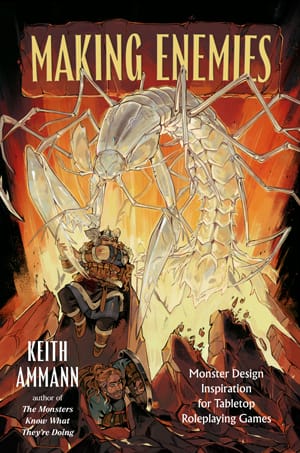
Making Enemies Wins an ENnie!
The ENnie Award voters have honored Making Enemies: Monster Design Inspiration for Tabletop Roleplaying Games with the 2026 Gold ENnie for Best Writing!
Writing this deep dive into creating original monsters for TTRPGs kicked my butt. The research involved, the creation of stat blocks in five different systems (two of which I began the process unfamiliar with), the playtesting, the unanticipated obstacles in the publishing process: All these factors combined to make it the most challenging effort I’ve ever undertaken. It’s also been the most rewarding and the one I’m proudest of, because it includes the greatest amount of my own original thinking. I’m gratified to have this work recognized by both the ENnie judges (who nominated it in two categories, Best Aid/Accessory–Non-Digital and Best Writing) and the ENnie voters.
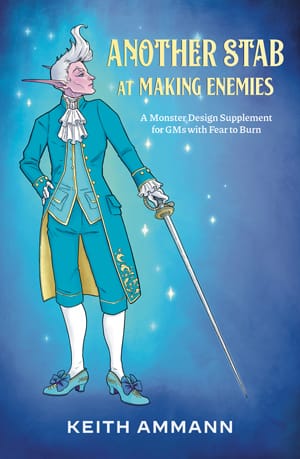
As I suspected, Daggerheart ran the table, winning Gold in every ENnie Award category in which it had been nominated (Product of the Year, Best Game, Best Rules, Best Free Game/Product and Best Streaming Content). Which is fortuitous, since I recently released Another Stab at Making Enemies, my Daggerheart “DLC” for Making Enemies. In celebration, I’m extending my introductory pricing of Another Stab to readers of this newsletter through the end of August. Use coupon code 1FFAUG to receive the discount.
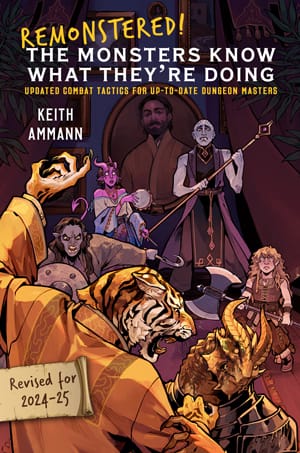
Remonstered! The Monsters Know Only Two Months Away
Everything about this book went so slowly for such a long time; now it’s all happening very, very fast. It’s now just over two months to the Oct. 6 release date of Remonstered! The Monsters Know What They’re Doing. If you haven’t preordered it already, do that today! Publishers love preorders, and authors haven’t been feeling a lot of love from their publishers lately, so this is one way you can help us out.
I’m still assembling my 2026–27 convention tour schedule, but two stops are already nailed down: Gamehole Con in Madison, Wis., Oct. 15–18, and PAX Unplugged in Philadelphia, Dec. 4–6. I look forward to having more to announce very soon!