OMG VTT AI SMH QQ

Hello, readers. It’s my first day back at the keyboard after not one but two colds, one following right on the heels of the other—one of the multifarious joys of being the parent of an elementary school–age child.
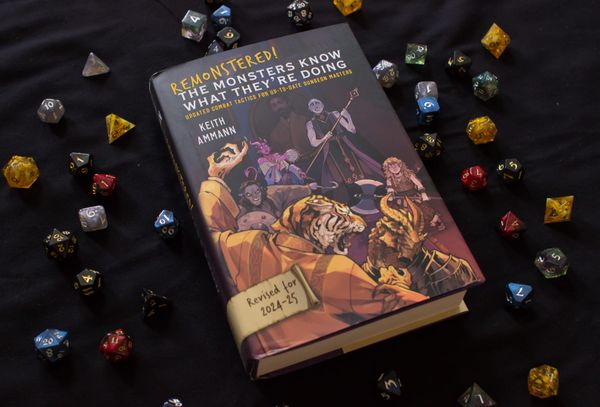
So what have I been up to? Well, mostly trying to get the word out about Remonstered! The Monsters Know What They’re Doing, in between naps and trips to fetch a new tissue box. (There’s also a side project I’m working on, or maybe it’s my main project, but … it’s not roleplaying game–related, and it’s nowhere near finished, so further information about that is going to have to wait until another day.) What I haven’t been up to very much is playing anything, or thinking about what I play. Too many things have been crowding it out.
Which is why it took me a while to get around to responding to something I saw on Bluesky: An account that maintains a TTRPG AI/NFT blocklist posted an update to the list. I don’t subscribe to that list, despite being a certified AI Hater, because even I am not quite as much of a purist as the maintainer of this list, who takes a shoot-first-ask-questions-later approach and has, in my opinion, included at least one individual for (as far as I can tell) his association with a generative AI enthusiast, as a podcast cohost, even though he’s not a genAI enthusiast himself.
Anyway, the latest iteration of the list included Owlbear Rodeo.
I asked why, and the list maintainer replied, “That'd be due to the head dev admitting to using AI in coding on their own subreddit.”
Well, that called for some follow-up.
The admission in question was posted in a thread following a link to an Owlbear Rodeo blog post, “On Plagiarism, AI and Centaurs.” I encourage you to read that post before continuing.
In response to that blog link, a Reddit user asked, point-blank, “Are you using AI assisted coding for your dev work on Owlbear Rodeo?”
The developer’s reply was … awkward, to say the least.
Yeah that’s a lot about what spurned [sic] this post.
We’ve been small bits [sic] of AI assisted code development for a while. In a code editor it worked a little like autocomplete. I’d start writing the syntax for a for loop and it will add the rest of the plumbing work then I can start writing the actual logic. Then the editors started offering tools where it would write the logic, I would describe the algorithm I wanted and it would put fill in the blanks [sic]. Then they started offering tools where it would build a full feature just by describing it. I first tried this when we were building our custom sync engine and it was a disaster so I deleted everything and wrote it from scratch.
Now the AI coding tools are one step removed from this again, they want to build the whole app for you (they don’t even show you the code anymore). And I’ve been trying this for a lot of this year. It’s supposed to be so much faster. But again it’s always just a disaster and I’ve thrown most of that code out.
So yeah we’ll still use a little bit of AI to autocomplete our syntax, or write the algorithm I want. But for the foreseeable future we won’t be anywhere near the vibe coding area of the industry.
And just to make doubly sure, this doesn’t mean we support AI in any other capacity. We haven’t and will never use AI art, music or anything in a creative capacity.
Now, you can read this two ways, depending on your tolerance for nuance.
1. The developers of Owlbear Rodeo use AI. That’s all that matters.
2. The developers of Owlbear Rodeo recognize that AI is lousy for most coding jobs, and they use it only for that very limited subset of tasks that it is good for, while rejecting it entirely in other arenas.
Of course, you can subscribe to interpretation 2 and also take it one step further:
2a. But they do use AI, and that’s all that matters.
And I’ll be honest: I’m very, very sympathetic to interpretation 2a.
However, I find myself running into a quandary sometimes referred to as “There Is No Ethical Consumption Under Capitalism.”
Here’s a straightforward example. I own a mobile phone. If I want to use that phone, I can receive service from AT&T, T-Mobile, or Verizon. All three of those companies have donated large sums of money to the campaigns and personal projects of a radical, reactionary, authoritarian political figure who has engaged and continues to engage in corruption, human rights violations and war crimes with a brazenness that was unfathomable in this country just 10 years ago. Indirectly, my mobile phone use supports this corruption and these violations. The clearly ethical position would be to get rid of my mobile phone. But in doing so, owing to the proliferation of two-factor authentication, I’d lose access to around 80 percent of the Internet services I use. Effectively, I’d have to move my whole life off-grid. That choice would dramatically inconvenience not only me but my family as well, and it wouldn’t budge any of these companies an inch.
There are some areas in my life in which I have independent alternatives to this kind of corporate villainy. I can patronize local, independently owned groceries and food co-ops, and I do; I don’t have to shop at Kroger-owned Mariano’s. I can check out DVDs from the public library, and I do; I don’t have to subscribe to Disney+, Paramount Plus or Apple TV. I can keep my money at a locally headquartered regional bank, and I do; I don’t have to open accounts at Chase, Bank of America or Wells Fargo. I can support local, independent booksellers, and I do; I don’t have to buy from Amazon. (Except when I do, because there are some things you flat-out cannot buy from normal, brick-and-mortar stores anymore. Even then, I ask myself, “Is this something I really need?” and often the answer is “no.” Sometimes, though, the answer is “yes.”)
So how much choice do I have when it comes to choosing a virtual tabletop, given the direction in which computer programming is moving? Is it feasible to choose a virtual tabletop whose coders don’t use generative AI for anything at all? Is it even possible?
Outlook Not So Good
As physically and mentally tired as I was, and resenting having to research the question at all, I pulled on my long-unworn journalist pants and sent the same two questions to the contact address of every VTT I could find (except for one: I neglected to submit my questions to the D&D Beyond Maps dev team. Just straight-up flaked on it. I plead sickness brain):
- To what extent do you encourage (or discourage) the use of AI-generated content (text, graphics, plugins) on your platform?
- To what extent do you use generative AI in the development of your code?
Here’s what I got back.
Beyond Tabletop
Actually, I didn’t send the questions to Beyond Tabletop, because the contact link on the website is nonfunctional. So are its alleged privacy policy and terms of service links. Its logo has a strikingly AI-generated appearance. I think that tells us everything we need to know. To be frank, the whole thing is as sketchy as a hand-drawn dollar bill.
Quest Portal
Quest Portal also doesn’t have an e-mail contact link, but its site includes the following unambiguous statement: “AI has been a part of our vision for making TTRPGs more accessible for years and will remain so as we move forward. It’s a subject that we, as Quest Portal founders, have known very well since our very first forays in the field together in 2008, and we have been baking AI technology into everything we do at Quest Portal.” It also has clearly AI-generated art splashed across its home page.
Alchemy
Alchemy doesn’t have an e-mail contact link either, but it does have the following statement in the Frequently Asked Questions list on its home page: “We believe that training AI models on creative works without the artist’s consent is unethical and harmful to the creative community. For that reason, no products created using AI-generated art or writing are permitted on the Alchemy Marketplace. We’re committed to supporting human creators and encourage thoughtful, original work from our partners.” It doesn’t say anything about the coding, though.
Fantasy Grounds
Fantasy Grounds didn’t reply to my questions, but on its forums, you can find links to all sorts of AI plugins, which it clearly encourages. (Here’s one example; here’s another.)
Roll20
Roll20 didn’t reply to my questions. It has a policy that it doesn’t allow “commercial content primarily written by AI language generators” to be sold through its Marketplace. I couldn’t find any official statement on whether it uses AI in coding, but based on the complaint that Roll20 introduced a feature just three months after Owlbear Rodeo did, despite never having done so previously while holding pole position in the VTT market for a decade, reasonable suspicions are warranted.
Owlbear Rodeo
Owlbear Rodeo didn’t reply to my questions, but I don’t think it would have told us anything we don’t already know from the blog post and the Reddit reply.
Foundry VTT
Foundry did reply to my inquiry:
You’ll find the answers you are looking for in our public “AI Content Policy” (https://foundryvtt.com/article/ai-policy/) which governs permitted use of generative AI for content on the Foundry VTT platform.
Our team follows this same policy internally. We sometimes use generative AI for tasks like feedback categorization, backlog management, automated testing, code review, or assistance with improving our software code. We don’t permit (or use) generative AI for the creation of written text, visual media, audio media, or marketing materials.
Foundry hosts a number of AI-driven add-on modules on its site; here are two examples.
Harpy
Harpy seems like it’s still at a relatively early stage in its development, but its dev took the time to write me a lengthy reply:
AI is a sensitive topic. Even more in the TTRPG industry I would say. The debate clearly lacks nuance. People are angry. That said, I’ll try to answer as honestly as I can.
AI art
Harpy doesn’t use any AI-generated artwork (all artists have been commissioned and are credited on the homepage) (Corinne Caro, Alice Yin, Eric Belisle).
AI translation
Harpy is translated in 16 languages, I write the French and English translations. Some users maintain the Italian and German versions. The rest is fully AI generated. For me it’s about inclusivity. Most TTRPG content and apps are only available in English and I think that’s not fair to TTRPG lovers around the globe.
AI content
I’m working on a Marketplace so people can share (and sell) their content (scenarios, codices, maps, presets, etc) as bundles without any commission (soon to be released) so I’ll have to take a stand on AI generated content. I’ll discourage it but no witch hunt. I’ll probably add some “AI art” or “AI content” or “Enhanced with AI” tags so people can filter out what they don’t want. But it will be based on trust.
AI in code
About the code now, that’s another matter. I’ve been coding for 18 years now. I’ve become an expert at my craft. But things have changed. I don’t think anyone still writes code manually. The ones who say they do are either lying or about to be left behind. But it brings an interesting question:
“What does the human actually bring to the table now that machines are so good?” (gotta see this if you haven’t yet, it’s very good: https://www.human-md.ai)
Short answer, it's “taste”
Putting the code aside allows me to think more about the user experience than the technical limitations. It makes Harpy better. It lets me focus on what matters to people. How they feel when they’re using Harpy. I feel like my value shifted from developer to UX designer.
[That said, I don’t vibe code Harpy (It’s too big to be vibe coded I think). I have a full understanding of the engine, the data models, the mixins, the components and the design system. I never ship something that I’m not technically proud of]
But it’s not only taste for me. It’s also about vision. Machines can make whatever piece of program now. But I’m not creating whatever piece of program. I have a very clear vision of what I want Harpy to be:
• Game agnostic (D&D is everywhere but I want Harpy to work with any game, so I created a flexible system that works for any game mechanic) (the upcoming release make that even better)
• Built in public (people request feature, I add it to the roadmap and they can vote on the roadmap to guide the next releases. Also revenues and metrics are shared openly every month on the app)
• Open (I’ve created an open source format so anyone can export or import content. No lock-in, they can leave Harpy with their stuff anytime they want)
• Inclusive (Translated in 16 languages, use gender neutral as much as possible, accessibility features, etc)
• Fair (95% features of free, single 10$ subscription with a 50% voucher if you ask one, no questions asked)
• People own their craft (Harpy doesn’t own anything created on the platform)
• Works on any device without any install
That’s the vision. Now, I don’t think a big company can bring that vision to life for me. It’s not interesting to them. Wouldn't make enough money. So no big company is going to build it for me. That’s why I’ve been building it myself for 7 years now (without ever paying myself). I’m telling you this because when I had to choose to use or not AI to code I had to ask myself if it was ethical to do so. I decided it was ok. People opinions may differ. Some may decide to not use Harpy for that reason. And that’s fine. I have a clear vision in mind and I want to offer it to my fellow story tellers out there. And I‘m doing it while having 3 toddlers at home, a full-time job and without burning out (the last part is not guaranteed to be honest).
I’d be happy to talk about it a bit more. Even though I’m French and it’s quite hard to talk about complicated subjects such as this one in a foreign language. By the way sorry for my bad English in this email. Felt wrong to use AI to answer you.
I agree with his judgment on that last point, at least.
Shard Tabletop
In contrast, here’s the reply I received from one of the developers of Shard:
• To what extent do you encourage (or discourage) the use of AI-generated content (text, graphics, plugins) on your platform?
[Hal] prohibit
• To what extent do you use generative AI in the development of your code?
[Hal] none
Whither Now?
So the answer is easy, right? Switch to Shard!
It’s not that easy.
Shard is designed for playing Dungeons & Dragons. Period. (The same is true of D&D Beyond Maps, even if I had thought to send the devs my questions and they’d given the best of all possible answers.) If all you play is D&D, that’s dandy. But I’ve used Owlbear Rodeo to play Shadowdark, Daggerheart, the Cypher System and Pathfinder, too. And somehow I don’t think that the maintainer of the TTRPG AI/NFT Blocklist’s ideal answer to the question of what to do about AI use in VTT coding is “Just play D&D exclusively!”
I should play only in person, then, and not use VTTs at all?
If I make that choice, I’m breaking up a group that’s met to play on an approximately weekly basis for 11 years. You know how rare and precious it is to have a group that’s played anywhere near that consistently for anywhere near that long. My group includes players who’ve moved out of state, who’ve undergone chemotherapy, and who have children keeping them at home during the evening. If we don’t play online, we don’t play.
So I should switch all my combat to theater of the mind?
I’ll tell you plainly, that won’t work with my group. We play at the end of the workday. My players are tired and distractible. Expecting them to keep track of positioning, ranges, targets and objectives with no visual cues simply isn’t reasonable.
In that case, I should stop playing games that involve grid-based movement and combat?
Not playing D&D at all—or any other game in which a battle map makes things easier to visualize—is as much of a nonstarter as playing nothing but D&D is, especially since D&D has been the glue that’s held my group together for more than a decade.
There is no ethical consumption under capitalism.
That being said, we can strive to be minimally unethical.
I believe we can take some heart from the fact that Owlbear Rodeo’s developers are sensitive to the general sentiment toward genAI among TTRPG players, recognize that it’s nowhere near everything it’s touted to be, and are in no rush to incorporate it into everything they do. I can only imagine how intense the bandwagonism is in the coding field, but I imagine that it’s insane, and that to push back against it to any degree must feel extremely daring, if not outright apostasy. I would rather embolden the devs to stand their ground against vibe coding, in the hope that they might in time feel confident enough to give up even the small amount of AI assistance they’re leaning on now (and to be honest, I can’t get mad at anyone for using an autocomplete feature, since I’ve been doing the same thing in my URL bar for the last 10 years to quickly look up monsters, spells and magic items on D&D Beyond). Refusing to use Owlbear Rodeo over the devs’ admission that they still take a wee dram of AI assistance here and there seems to me like a choice that would ultimately penalize me and my players, that wouldn’t penalize Owlbear Rodeo to any degree that it would feel, and that would simply mark me as someone whose opinion Owlbear Rodeo no longer needs to care about. I’d like to see it do better, but I don’t think severing the relationship is what’s going to make that happen.
Besides which, I chose Owlbear Rodeo as my preferred VTT for a variety of reasons, and all those reasons still stand. I don’t love the devs’ genAI use, or the fact that they weren’t fully candid about it. But given the times we’re in, given the state of the VTT market, given other platforms’ undisguised enthusiasm for genAI, I have to be honest: It doesn’t rise to the level that would compel me to either switch to another platform or exit the market altogether. For now, rather than refuse to use any VTT that makes use of AI at all, I’m—well, not content, but grudgingly accepting of using the system-agnostic VTT that makes use of it the least, ostensibly feels the most conflicted about it, and doesn’t expect me to engage with it in any way, shape or form.
That’s my own calculus, though. If you play nothing but D&D, maybe consider switching to Shard.
Upcoming Appearances
Dec. 4–6: Signing at PAX Unplugged, Pennsylvania Convention Center, Philadelphia. Catch me from 3 to 6 PM Friday and 11:30 AM to 1:30 PM Sunday in the Expo Hall autographing area. In addition to these signing events, my books will be available for sale at the Adams Media booth (#2657), and I’ll be there to chat with folks from 2 to 4 PM on Saturday.
Jan. 21–24, 2027: I plan to be at ConFusion, Sheraton Detroit Novi Hotel, Novi, Mich. Further details to come. Canceled. Couldn’t make it pencil out.
Jan. 28–31, 2027: I will be at Capricon, Marriott Chicago O’Hare, Chicago. Further details to come.
Feb. 12–14, 2027: I will be at Polar Vortex, Sheraton Lisle Naperville, Lisle, Ill. Further details to come.
Still waiting to hear whether my Writers’ Block applications are approved by Emerald City Comic Con and C2E2. Fingers crossed.
Hear Me Blather
New podcast interviews posted! Hear me on: